

Fever in Children
Sometimes children develop fevers. Here are some things for you to know.
The most common cause of fever in children is infection. For example, children can get a fever if they have:
- A cold, flu or covid.
- An airway infection, such as croup or bronchiolitis.
- A stomach bug.
- In some cases, children get a fever after getting a vaccine.
What is a fever?
Fever is a rise above the average body temperature. In general, 38°C (100.4ºF) is considered a fever. A fever is a symptom, not a disease, usually caused by an infection or a normal vaccine reaction.
Not all fevers are dangerous. A child with a mild infection can have a high temperature, while a child with a severe infection might have no fever. Higher temperatures do not mean an illness is more serious; how your child looks and acts is a more important measure of an illness.
Types of thermometers to use:
You might get slightly different numbers than those above depending on where you take your child’s temperature – mouth, armpit, ear, or bum.
Digital thermometers are the most accurate and can be used in the bum (rectally), in the mouth under the tongue (orally), or in the armpit (axillary).
If you find using a thermometer in the bum or mouth to be difficult, ask your healthcare provider if you may use:
- A thermometer for the forehead (temporal artery thermometer) if your child is at least three months old.
- A thermometer for the ear (tympanic thermometer) if your child is older than six months. This method only works if you use the device exactly as directed.
Plastic strip thermometers, pacifier thermometers, glass thermometers, or smartphone temperature apps are not reliable methods to take a child’s temperature.
How do I take my child’s temperature?
Here are some tips to remember for any method you use:
- Avoid taking your child’s temperature right after a bath as this can affect the reading.
- Stay with your child while taking a temperature.
- mercury glass thermometers are dangerous for your child if they break.
- Be sure to read the package instructions for your thermometer.
- Follow the cleaning instructions on the package before and after use.
- Always label a thermometer used in the bum clearly, and never use it in the mouth.
- Dab a small amount of petroleum jelly on end.
- Lay your child face down across your lap
- Gently insert the thermometer into the child’s anus (bum) until the silver tip is not visible (1/4 to 1/2 inch or 6 to 12 millimeters).
- Hold the thermometer in place.
- After about 1 minute, you will hear the beep.
- Remove the thermometer and read the temperature.
The armpit is not as accurate as a rectal temperature. If this method does not show a fever, but your child feels warm and unwell, take a rectal measurement.
- Put the thermometer tip in the middle of your child’s dry armpit.
- Make sure your child’s arm stays snugly against their body.
- Hold the thermometer in place.
- After about one minute, you will hear the beep.
- Remove the thermometer and read the temperature.
The ear method is quick but can give temperature readings that are too low, even when following the manufacturer’s directions.
- Gently tug on the top of the ear and pull back to make a better path inside the ear to the eardrum.
- Gently insert the thermometer and seal off the ear canal.
- Squeeze and hold the button for one to two seconds.
- Remove the thermometer and read the temperature.
Taking an oral temperature is easier in an older, cooperative child.
- Wait 30 minutes after your child eats or drinks, and make sure there’s nothing in your child’s mouth.
- Wash the thermometer with cool water and soap, then rinse it.
- Place the thermometer’s tip under the tongue and ask your child to close their lips around it, not their teeth. Remind your child not to bite down or talk and relax and breathe normally through the nose. If they cannot breathe through their nose, use another method.
- Wait until you hear the beep that the temperature is ready to be read (usually one minute in digital thermometers).
What is a normal temperature?
| Method | Normal temperature range | Fever |
| Rectum | 36.6°C to 38°C (97.9°F to 100.4°F) | 38°C or higher (100.3°F or higher) |
| Armpit | 36.5°C to 37.5°C (97.8°F to 99.5°F) | 37.6°C or higher (99.6°F or higher) |
| Ear | 35.8°C to 38°C (96.4°F to 100.4°F) | 38°C or higher (100.5°F or higher) |
| Mouth | 36°C to 37.5°C (97.2°F to 98.6°F) | 37.6°C or higher (99.6°F or higher) |
What do I do if my child has a high temperature (fever)?
Call your healthcare provider immediately if your child:
- is under three months of age.
- appears to be and acts very ill; or
- has a rash, cough, or wheeze with the fever.
Call your healthcare provider within 24 hours if your child is:
- between three and six months of age.
Call your healthcare provider if:
- the fever has lasted over 24 hours with no obvious cause.
- the fever lasts more than three days.
- the fever returns within 24 hours of relief; or
- you are concerned.
What can I do to help my child feel better?
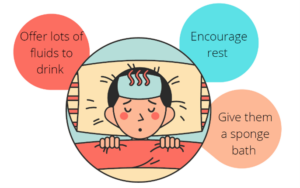
- Offer lots of fluids to drink. Call 811 if your child does not drink fluids for more than a few hours.
- Encourage rest, as much as they want. Your child can go back to school or do other activities when their temperature has been in the normal range for more than 24 hours.
- A sponge bath with warm water may help.
- It is dangerous for a child to use rubbing alcohol on their skin or in the bath.
- Medicines, such as acetaminophen (like Tylenol) or ibuprofen (like Advil or Motrin), can help. But these medicines are not always necessary. For example, a child older than three months who has a temperature of less than 38.9ºC (102ºF) and is otherwise healthy and active does not need treatment.
- It is dangerous to give aspirin to a child under 18 years old. Aspirin can cause a dangerous condition called Reye syndrome.